 10 Aug 2026
How to wind down at night: a practical evening routine
Winding down is the part of the evening most people skip. It is the hour or so before bed when the body is meant to shift out of being ready for things and into being ready for nothing much. Skip it and lying down in the dark becomes the moment you start that shift rather than finish it. That is when the ceiling gets interesting.
None of what follows is new. It is mostly light, temperature, and giving the evening a shape.
Start with the light
The body takes its cue for night from light, and it is not fussy about where the light comes from. Bright overhead lighting at eleven at night reads much the same to your body as a late afternoon. The fix is unglamorous. Turn the big lights off, use lamps, and keep the last hour dimmer than the rest of the evening.
Screens matter less than the room they sit in, which is the opposite of what most advice says. A phone at full brightness held close to your face is its own small floodlight. A dim phone in a dim room is a smaller problem than a bright ceiling.
Let your temperature fall
Core body temperature drops as you approach sleep, and that fall is part of the signal. A warm shower an hour or two beforehand helps by a slightly backwards route. It moves blood towards the skin, so your core temperature drops faster afterwards than it would have on its own. A bedroom kept on the cool side does the same job while you do nothing at all.
Put the work down before you put the phone down
The trouble with answering one more email at eleven is not the screen. It is that you have opened a loop you cannot close until tomorrow, and a mind handed an unfinished task keeps picking it back up. Writing tomorrow's list before you stop is a way of telling yourself the loop is parked somewhere safe.
Move the last coffee earlier than feels necessary
Caffeine has a long tail. A good share of an afternoon cup is still in you at bedtime, and it can flatten sleep quality even on nights when you fall asleep without trouble. In a city where the four o'clock kopi is close to a civic institution, this is the hardest item on the list. It is also the one people notice most when they move it.
Give the evening a shape
A routine works less because of what is in it than because it repeats. The same few things in the same order tell the body what is coming next. It can be a shower, a pot of tea, ten pages of something undemanding, the same short walk around the block. The content matters much less than the repetition, which is good news, because it means you can pick things you like.
Keep the bed for sleeping
If you work, scroll and worry in bed, the bed stops being a cue for sleep and becomes a cue for working, scrolling and worrying. Sleep clinicians take this seriously. The standard advice to get up and leave the room when you have been lying awake a while is not really about those twenty minutes. It is about not training yourself to believe that bed is the place where you lie awake.
When it is more than a routine problem
Everything above is for ordinary trouble settling at the end of a long day. Insomnia that runs for weeks, loud snoring paired with daytime exhaustion, or waking unrefreshed no matter how long you were down are worth taking to a doctor rather than to a routine. There are treatments with good evidence behind them, and for long-running insomnia the first thing most clinicians reach for is cognitive behavioural therapy rather than anything you can buy.
Where a drink comes into this
A drink is part of the shape of an evening, not a mechanism. That is the honest version, and we would rather say it than dress it up.
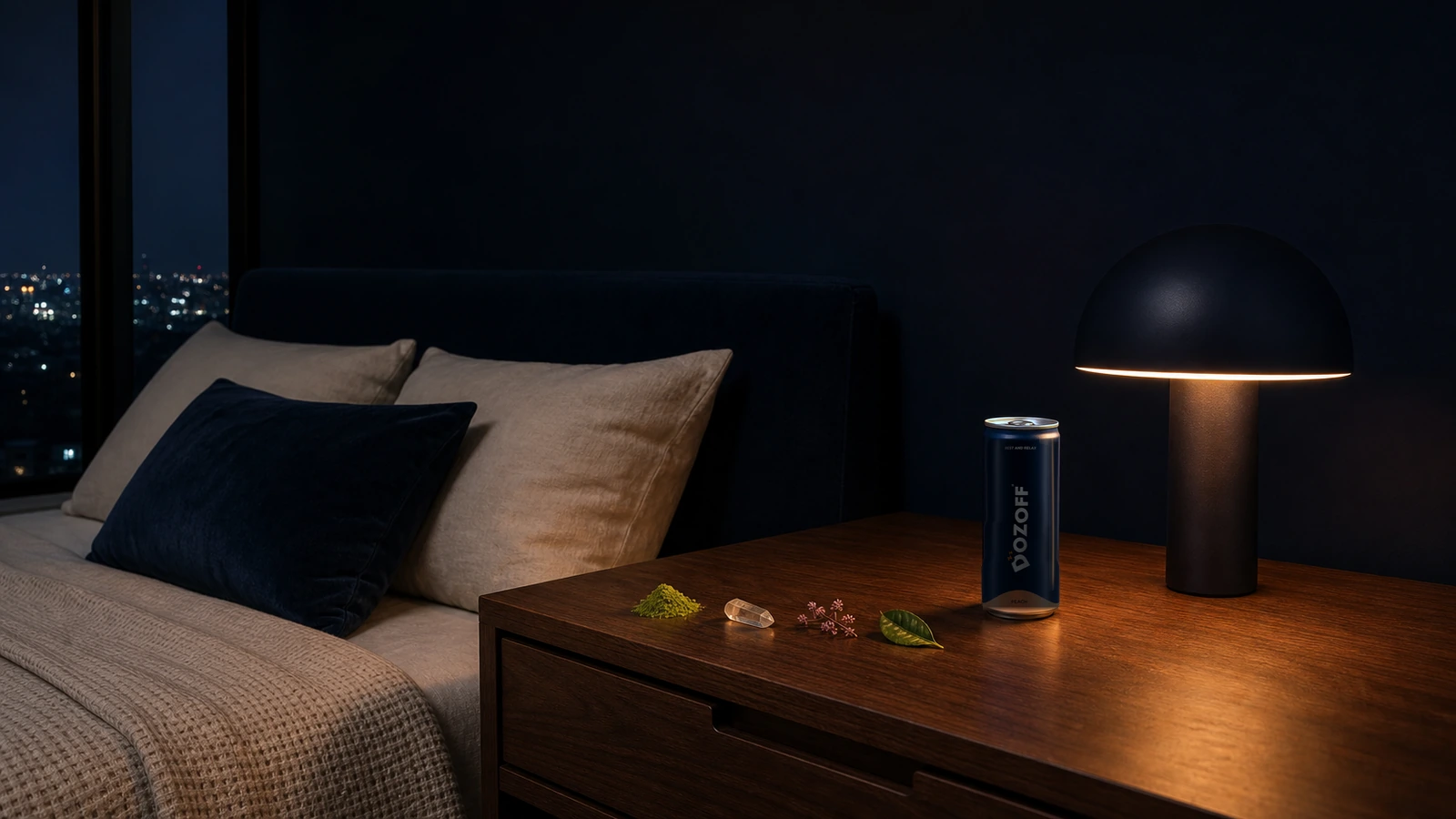
Dozoff is a non-carbonated peach tea in a 250 ml can that we make for that end of the day. It contains four ingredients that have been studied in relation to stress, relaxation and sleep: L-theanine, magnesium, valerian root and vitamin B6. The full ingredient list is on the can. It is not a medicinal product.
All four have been looked at in human trials. L-theanine has the most behind it: a meta-analysis of 31 randomised trials found a real short-term effect on attention and a modest reduction in stress. We have put all sixteen studies on our references page, with their sample sizes and what each one could and could not show, so you can read them rather than take our word for it.